Incident Context
- Component and version: Pinecone Python SDK v9.1.0 (pinned in
requirements.txt; Hands-on testing v9.0.x–v9.1.x All exist) - Deployment method: Pinecone Local running in a Docker container (exposed ports
5080for control plane,5081for data plane) - Host OS: Ubuntu 22.04.3 LTS (kernel 6.2.0-39), also reproduced on Windows 11 WSL2
- Resource limits: N/A (no OOM or CPU throttling observed)
- Relevant config file paths:
~/autogpt/.env(AutoGPT environment variables)- Docker Compose override file (if used) for Pinecone Local
- Environment variables:
PINECONE_API_KEY="pclocal"(Pinecone Local requires this exact literal)MEMORY_BACKEND=pinecone(AutoGPT-specific, missing by default)ssl_verify=Falsepassed toPinecone()constructor
The Symptom
We spun up Pinecone Local to replace our cloud dependency during development. After running our ingestion script (python ingest.py), the process crashed immediately with an SSL handshake error. We assumed ssl_verify=False would disable TLS, so we added it. The error changed – but didn’t go away.
Next, we attempted to create a sparse index for keyword + dense hybrid search. The SDK refused to send the request, raising a client-side ValueError. When we tried to outsmart it by omitting the dimension field, the request finally reached the server – only to bounce back with a 422 Unprocessable Entity.
We spent about an hour going in circles between client-side validation and server-side requirements.
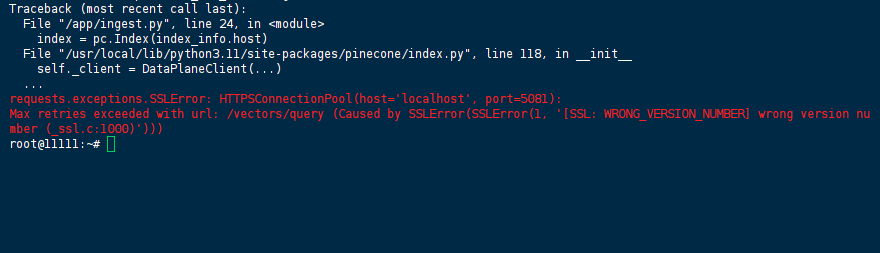
Raw Stack Trace / Error Log
First failure – TLS handshake (observed 2026-06-29):
Traceback (most recent call last):
  File "/app/ingest.py", line 24, in <module>
    index = pc.Index(index_info.host)
  File "/usr/local/lib/python3.11/site-packages/pinecone/index.py", line 118, in __init__
    self._client = DataPlaneClient(...)
  ...
requests.exceptions.SSLError: HTTPSConnectionPool(host='localhost', port=5081):
Max retries exceeded with url: /vectors/query (Caused by SSLError(SSLError(1, '[SSL: WRONG_VERSION_NUMBER] wrong version number (_ssl.c:1000)')))
Second failure – 422 Unprocessable Entity (sparse index creation):
pinecone.exceptions.PineconeApiException: (422)
Reason: Unprocessable Entity
HTTP response body: {"detail":"Request validation error: missing field 'dimension'"}
Third failure – client-side block (when we tried to supply dimension):
pinecone.exceptions.PineconeValueError: dimension must not be provided for sparse indexes
Fourth failure – raw POST bypass resulted in sparse upsert failure:
pinecone.exceptions.PineconeApiException: (400)
Reason: Bad Request
HTTP response body: {"detail":"Vector dimension 0 does not match the dimension of the index 1"}
Failed Attempts
Attempt 1 – Set ssl_verify=False and assume TLS is off
We added ssl_verify=False to the Pinecone() call. The error persisted. To understand why, we dropped into a Python REPL and printed the resolved host:
pc = Pinecone(api_key="pclocal", host="http://localhost:5080", ssl_verify=False)
info = pc.describe_index("my-index")
print(repr(info.host))
# Output: 'https://localhost:5081'   <-- note the scheme
We realized the SDK forcibly prepended https:// after the control-plane response. The ssl_verify flag only skips certificate validation – it does not switch the URL scheme to http. This path was a dead end without modifying the host string ourselves.
Attempt 2 – Omit dimension for sparse index
Per the SDK documentation (which we later found was outdated), sparse indexes don’t need a dimension. We omitted it. The SDK finally sent the request, but the local server rejected it with 422 and missing field 'dimension'. We checked Pinecone Local’s logs (docker logs pinecone-local --tail 20) and confirmed the server schema strictly requires dimension for all create operations.
Attempt 3 – Supply dimension for sparse index
We added dimension=128 to satisfy the server. The SDK blocked the request before transmission. We traced this to site-packages/pinecone/models/create_index_request.py and found validate_create_inputs raising an explicit error:
if vector_type == "sparse" and dimension is not None:
    raise PineconeValueError("dimension must not be provided for sparse indexes")
We were stuck: server wants it, SDK forbids it.
Attempt 4 – Bypass SDK entirely using requests.post()
We grabbed the server endpoint directly (http://localhost:5080/indexes) and sent a raw JSON payload with "dimension": 128 and "vector_type": "sparse". The index was created successfully (no 422). But when we tried to upsert sparse vectors, we got a 400 – dimension mismatch. We queried the index metadata and found Pinecone Local had silently created a dense index, completely ignoring vector_type. That confirmed Pinecone Local simply doesn’t support sparse indexes yet.
Root Cause Analysis
We dug into the SDK source to understand the TLS behavior. In pinecone/core/client/data_plane.py, the Index constructor calls normalize_host (from pinecone/utils/__init__.py). This function wraps any bare hostname with https://. The control-plane response from Pinecone Local returns "host": "localhost:5081" – no scheme. By the time ssl_verify=False is applied, the scheme is already https://, and the underlying urllib3 pool attempts a TLS handshake against a plain HTTP port.
For sparse indexes, we identified two conflicting design assumptions:
- SDK assumption (cloud-first): The Pinecone cloud API does not require
dimensionfor sparse indexes because the server infers it from the first upsert. The SDK enforces this cloud behavior. - Local server assumption: Pinecone Local implements a stricter, schema-first validation where
dimensionis mandatory at creation time.
On top of this, the local server does not actually implement sparse storage – it accepts vector_type in the request but discards it. This is a gap in the local emulation layer.
In the AutoGPT context (Issue #711), the failure was different but related: the MEMORY_BACKEND environment variable was missing. We checked AutoGPT’s config.py and saw it defaults to local if unset, so Pinecone never got initialized. Setting the variable unblocked that path, but then we hit the same TLS and sparse-index issues above.
The Solution / Workaround
Permanent fix – upgrade SDK to a version including PR #680
PR #680 adjusts two critical areas:
- In
_resolve_index_host, ifssl_verify=False, it rewriteshttps://tohttp://on the resolved host – but only if the host was resolved from the control plane. Explicitly passed hosts remain untouched. - In
validate_create_inputs, the prohibition ondimensionfor sparse indexes is removed. The field becomes optional and is forwarded as-is.
Update your requirements.txt to pull the latest commit (or wait for the next official release post-v9.1.0):
pip install git+https://github.com/pinecone-io/python-sdk.git@main
Workaround 1 – TLS (if you must stay on v9.1.0)
Override the host scheme manually after describing the index:
from pinecone import Pinecone

pc = Pinecone(api_key="pclocal", host="http://localhost:5080", ssl_verify=False)
info = pc.describe_index("my-index")
# Force HTTP
fixed_host = info.host.replace("https://", "http://")
index = pc.Index(host=fixed_host)

# Now upserts and queries will use HTTP
index.upsert(vectors=[...])
Workaround 2 – Sparse indexes on local
Since Pinecone Local ignores vector_type, the only practical workaround is to use dense indexes for local testing and run sparse-specific integration tests against Pinecone cloud. If you must test sparse logic locally, consider mocking the Pinecone client or using an alternative vector DB for that specific test suite.
AutoGPT – explicit configuration
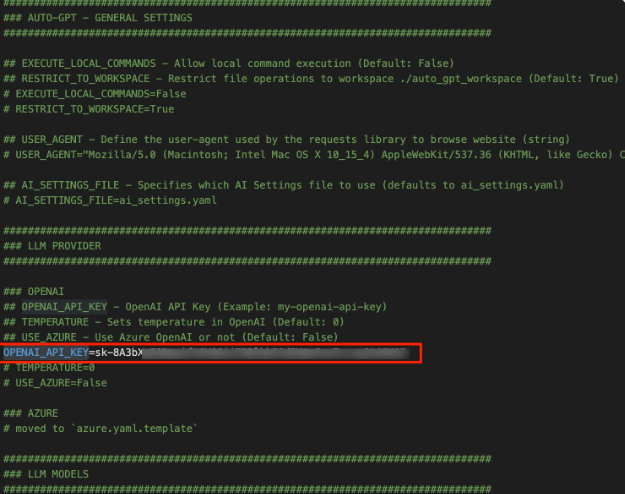
Edit ~/autogpt/.env and add:
MEMORY_BACKEND=pinecone
PINECONE_API_KEY=pclocal
PINECONE_ENV=local  # or whatever your local env name is
We also had to delete an old index to avoid quota errors (The index exceeds the project quota of 1 pods). Run pc.delete_index("old-test") before creating new ones.
Verification
Check TLS fix – run this snippet and confirm no SSL errors:
pc = Pinecone(api_key="pclocal", host="http://localhost:5080", ssl_verify=False)
info = pc.describe_index("test-index")
idx = pc.Index(host=info.host.replace("https://", "http://"))
print(idx.describe_index_stats())  # Should return stats, not SSLError
Check index creation – confirm that dimension can now be passed without client-side errors (after PR #680):
pc.create_index(
    name="sparse-test",
    dimension=128,          # Now allowed by SDK
    metric="cosine",
    vector_type="sparse",   # Sent to server, though ignored locally
    spec=ServerlessSpec(cloud="aws", region="us-east-1")
)
Check AutoGPT – run AutoGPT and grep for memory initialization:
./run.sh | grep -i "pinecone"
# Expected output: "Using memory backend: pinecone"
Prevention
- Pin SDK version with caution: Always test new SDK versions against your local environment before deploying. We now run a small
health_check.pyscript in CI that exercises both TLS and index creation against Pinecone Local. - Add a startup hook: In your application entrypoint, assert that the resolved index host uses the correct scheme. If it starts with
https://and you’re targeting local, raise a clear error or auto-apply the replacement. - Monitor Pinecone Local releases: Check the changelog for sparse-index support before refactoring hybrid search logic.
- Environment variable linting: For AutoGPT, we added a validation step that checks
MEMORY_BACKENDis set and warns if it defaults tolocal. - Use
curlfor sanity checks: Before writing Python code, we nowcurl -X GET http://localhost:5080/indexesto confirm the control plane is alive and returns expected schemas.
References
- GitHub Issue #678 – TLS forced to https for Pinecone Local – we referenced the
normalize_hostcall stack here. - missing
MEMORY_BACKENDvariable. - Pinecone Local Development Documentation
Last verified: June 2026 (Pinecone Python SDK v9.1.0, Pinecone Local Docker image pinecone-local:latest, Ubuntu 6.2.0-39, Python 3.11)
